Calorie Calculator

Calorie Calculator

Calorie Calculator

The Calorie Calculator can be used to estimate the number of calories a person needs to consume each day. This calculator can also provide some simple guidelines for gaining or losing weight.

ages 15 - 80
cm
kg

  • Exercise: 15-30 minutes of elevated heart rate activity.
  • Intense exercise: 45-120 minutes of elevated heart rate activity.
  • Very intense exercise: 2+ hours of elevated heart rate activity.

 The Science of Calorie Calculation

This Calorie Calculator provides an estimated average of your daily energy needs based on several established formulas. Understanding these formulas helps you appreciate the nuances of metabolic rate measurement.

The calculation starts with the Basal Metabolic Rate (BMR), which is the amount of energy (calories) your body burns per day simply to stay alive at rest (breathing, circulating blood, maintaining body temperature, etc.).

Key BMR and RDEE Formulas

Historically, the Harris-Benedict Equation was the first widely used method, though it was revised in 1984. The current gold standard for estimating BMR is the Mifflin-St Jeor Equation, which has been shown to be more accurate for the general population.

A different approach is the Katch-McArdle Formula, which calculates Resting Daily Energy Expenditure (RDEE). Unlike the others, this formula accounts for lean body mass, making it potentially more accurate for individuals who are leaner and know their body fat percentage.

Here are the specific formulas used by the calculator:

Equation NameFor Men (BMR/RDEE)For Women (BMR/RDEE)Variables
Mifflin-St Jeor$10W + 6.25H – 5A + 5$$10W + 6.25H – 5A – 161$$W=$ weight (kg), $H=$ height (cm), $A=$ age
Revised Harris-Benedict$13.397W + 4.799H – 5.677A + 88.362$$9.247W + 3.098H – 4.330A + 447.593$$W=$ weight (kg), $H=$ height (cm), $A=$ age
Katch-McArdle$370 + 21.6(1 – F)W$ (same for both)$370 + 21.6(1 – F)W$ (same for both)$W=$ weight (kg), $F=$ body fat (decimal, e.g., 20% = 0.20)

🏃 From BMR to Daily Calorie Needs

The BMR/RDEE value gives you the calories needed to sustain yourself at rest. To find your actual Total Daily Energy Expenditure (TDEE), the BMR/RDEE is multiplied by an Activity Factor based on your typical exercise level (generally ranging from 1.2 for sedentary to 1.95 for extremely active). This accounts for all movement and exercise throughout the day.

Weight Loss Guidelines

The fundamental principle of weight change is that 3,500 calories equates to approximately 1 pound (0.45 kg) of body weight.

  • To lose 1 pound per week, you need a daily calorie deficit of 500 calories (3,500 calories / 7 days).

    • Example: If your TDEE is 2,500 calories to maintain weight, consuming 2,000 calories per day for a week should result in a 1-pound loss.

  • Safety Warning: It is strongly recommended not to reduce your calorie intake by more than 1,000 calories per day, as losing more than 2 pounds per week can be unhealthy. Rapid, drastic weight loss can lead to:

    • Metabolism reduction (making long-term maintenance harder).

    • Muscle loss (which further lowers your BMR).

    • Unhealthy rebound (weight often regained as fat).

Calorie Counting as a Weight Loss Tool

Calorie counting, when done mindfully, can be an effective way to manage weight and increase nutritional awareness.

A Basic Strategy for Calorie Counting

  1. Estimate Your TDEE: Use a calculation like the one provided here. If you know your body fat, the Katch-McArdle formula might be best. Remember, all results are approximations!

  2. Set Realistic Goals: Aim for a 500-calorie daily deficit for a 1-pound weekly loss. Consult a doctor or Registered Dietitian Nutritionist (RDN) if planning a deficit greater than 1,000 calories/day.

  3. Choose a Tracking Method: Use a smartphone app, website, spreadsheet, or even a simple journal. Meticulous tracking initially makes it much easier to accurately estimate portion sizes and calorie counts later on.

  4. Monitor and Adjust: Track your progress over time. Weigh yourself consistently (e.g., first thing in the morning, before breakfast) and measure changes over longer periods (like a week), rather than daily, to account for natural variations like water weight.

  5. Stay Consistent!

The Importance of Calorie Quality

While the “calories in vs. calories out” rule is fundamental, the source of those calories matters for health and satiety:

  • Satiety and Digestion: Foods that require more chewing and are difficult to digest (like fruits, vegetables, lean meats, and whole grains) tend to leave you feeling fuller longer and result in the body burning slightly more calories during digestion (the thermic effect of food).

  • Empty Calories: Calories from added sugars and solid fats (like many sodas and processed snacks) offer little to no nutritional value. These should be limited.

  • Beware of Labels: Foods labeled as “reduced-fat” often have large amounts of added sugar to maintain taste. Always check the full nutrition label!

  • Portion Control: Many people underestimate their intake because they are accustomed to oversized portions. Using a smaller plate can help with portion control.

 Zigzag Calorie Cycling 

One challenge of long-term calorie restriction is that the body can adapt to the lower intake, leading to a weight-loss plateau. Zigzag calorie cycling is a strategy to prevent this adaptation.

This method involves alternating high-calorie and low-calorie days to meet the same total weekly calorie target.

  • Goal: To maintain the weekly deficit necessary for weight loss while preventing the metabolism from settling into a routine.

  • Benefit: This offers greater dietary flexibility, allowing you to plan higher-calorie days around social events or for a needed “cheat day,” while making up the deficit on other, lower-calorie days.

  • Guidelines: High-calorie and low-calorie days often vary by 200-300 calories, with higher variations recommended for people with higher activity levels.

Calorie and Energy Data

General Daily Calorie Needs

Group (U.S. Dept. of Health Estimates)Recommended Daily Calorie Intake (to maintain weight)
Adult Males2,000–3,000 calories
Adult Females1,600–2,400 calories
Minimum Intake (Per Harvard Health)

1,500 (men), 1,200 (women)

Energy Content of Macronutrients

Food ComponentKilojoules (kJ) per gramCalories (kcal) per gram
Fat378.8
Proteins174.1
Carbohydrates174.1
Ethanol (Alcohol)296.9

Exercise Calorie Burn Examples (per hour)

Activity125 lb (57 kg) Person185 lb (84 kg) Person
Walking (3.5 mph)215 Cal319 Cal
Swimming (moderate)397 Cal587 Cal
Running (9 min/mile)624 Cal923 Cal
Bicycling (12-14 mph)454 Cal671 Cal
 

Margin Calculator

Profit Margin Calculator

Profit Margin Calculator

Calculate the profit margin of making, trading products, or doing business in general. Please provide any two of the following to calculate the rest values.

%
Result 💾 save
Margin: 0.00%
Profit: $0.00
Markup: 0.00%

Cost: The cost of the product.

Revenue: The income generated by selling the product.

Profit: The money left after deducting cost from revenue.

Margin: The percentage of profit vs. revenue.

Markup: The percentage of profit vs. cost.

💰 Master Your Profits with Our Free Margin Calculator

Are you struggling to quickly determine the health of your business or the profitability of a specific product? Understanding the relationship between Cost, Revenue, Profit, Margin, and Markup is crucial for success, yet calculating these figures can be time-consuming.

Our free online Profit Margin Calculator tool is designed to provide instant, accurate results, helping you make smarter pricing and purchasing decisions right now.


How Our Margin Calculator Works

What sets this tool apart is its flexibility. Unlike simpler calculators, ours allows you to find any missing value as long as you provide two known inputs.

The underlying formula for profit is simple: Profit = Revenue – Cost. However, calculating the percentage relationships (Margin and Markup) often leads to errors. Our tool eliminates this guesswork.

Input any two fields to calculate the rest:

  • Cost: The amount spent to produce or acquire the goods.

  • Revenue: The total income received from sales.

  • Profit: The financial gain made after all expenses (Cost) are subtracted.

  • Margin (%): The percentage of Revenue that is pure profit. (Formula: Profit / Revenue)

This makes it the perfect markup calculator and gross profit margin calculator wrapped into one.


Why Accurate Margin Calculation Matters

Knowing your exact profit margin is essential for long-term strategy:

  1. Pricing Strategy: It informs you how low you can drop a price during a sale without losing money.

  2. Product Selection: It highlights which products are truly profitable, allowing you to focus inventory and marketing efforts where they matter most.

  3. Investment Decisions: Calculating your margin before increasing your Cost (e.g., buying better materials or paying higher salaries) tells you if the investment is viable.

Use the instant feedback from the donut chart visualization to see the direct relationship between your Cost and Profit at a glance. Plus, our secure download feature lets you save your results directly to your desktop (like Notepad) for record-keeping and historical analysis.

Stop guessing your profitability. Input your values above and gain clear insight into your financial performance today!

BMI Calculator

BMI Calculator

BMI Calculator

 Check Your Body Mass Index Instantly

The BMI Calculator helps you find out if your weight is healthy for your height and age. Simply enter your age, height, and weight, then click Calculate to see your BMI result.

BMI introduction

BMI (Body Mass Index) is a number that estimates body fat based on your height and weight. It classifies results into Underweight, Normal, Overweight, and Obese categories.

BMI table for adults

ClassificationBMI range (kg/m²)
Severe Thinness< 16
Moderate Thinness16 – 17
Mild Thinness17 – 18.5
Normal18.5 – 25
Overweight25 – 30
Obese Class I30 – 35
Obese Class II35 – 40
Obese Class III> 40

BMI Calculator – Check Your Body Mass Index Instantly The BMI Calculator helps you find out if your weight is healthy for your height. Simply enter your age, gender, height, and weight, then click Calculate to see your BMI result. The BMI Calculator works in both US and Metric Units, and also shows your Ponderal Index for a more detailed assessment.

BMI introduction

BMI (Body Mass Index) is a number that estimates body fat based on your height and weight. The BMI Calculator classifies results into four main categories: Underweight, Normal, Overweight, and Obese. A healthy BMI range is typically 18.5 to 25.

BMI table for adults

This is the World Health Organization’s (WHO) recommended body weight based on BMI values for adults. It is used for both men and women, age 20 or older.

ClassificationBMI range – kg/m2
Severe Thinness< 16
Moderate Thinness16 – 17
Mild Thinness17 – 18.5
Normal18.5 – 25
Overweight25 – 30
Obese Class I30 – 35
Obese Class II35 – 40
Obese Class III> 40

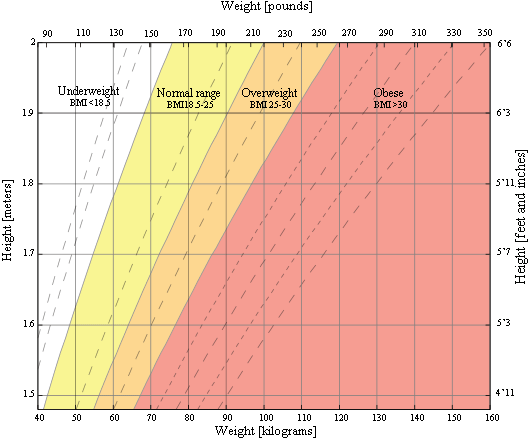
BMI chart for adults

This is a graph of BMI categories based on the World Health Organization data. The dashed lines represent subdivisions within a major categorization.

BMI table for children and teens, age 2-20

The Centers for Disease Control and Prevention (CDC) recommends BMI categorization for children and teens between age 2 and 20.

CategoryPercentile Range
Underweight<5%
Healthy weight5% – 85%
At risk of overweight85% – 95%
Overweight>95%

Understanding BMI Prime and Ponderal Index

The BMI Calculator also provides: BMI Prime – compares your BMI to the upper healthy limit (25). Ponderal Index (PI) – another indicator of body leanness, better for very tall or short people. Both values add more insight into your health beyond basic BMI results.

  • High blood pressure
  • Higher levels of LDL cholesterol, which is widely considered “bad cholesterol,” lower levels of HDL cholesterol, considered to be good cholesterol in moderation, and high levels of triglycerides
  • Type II diabetes
  • Coronary heart disease
  • Stroke
  • Gallbladder disease
  • Osteoarthritis, a type of joint disease caused by breakdown of joint cartilage
  • Sleep apnea and breathing problems
  • Certain cancers (endometrial, breast, colon, kidney, gallbladder, liver)
  • Low quality of life
  • Mental illnesses such as clinical depression, anxiety, and others
  • Body pains and difficulty with certain physical functions
  • Generally, an increased risk of mortality compared to those with a healthy BMI

As can be seen from the list above, there are numerous negative, in some cases fatal, outcomes that may result from being overweight. Generally, a person should try to maintain a BMI below 25 kg/m2, but ideally should consult their doctor to determine whether or not they need to make any changes to their lifestyle in order to be healthier.

BMI Formula

The BMI Calculator uses these simple formulas: Metric Units: BMI=weight(kg)/height(m)2. US Units:BMI=703×weight(lbs)/height(in)2.For example, a person who is 5’10” (178 cm) and 160 lbs (72.5 kg) has a BMI of 23, which is in the Normal range.

Risks associated with being underweight

Being underweight has its own associated risks, listed below:

  • Malnutrition, vitamin deficiencies, anemia (lowered ability to carry blood vessels)
  • Osteoporosis, a disease that causes bone weakness, increasing the risk of breaking a bone
  • A decrease in immune function
  • Growth and development issues, particularly in children and teenagers
  • Possible reproductive issues for women due to hormonal imbalances that can disrupt the menstrual cycle. Underweight women also have a higher chance of miscarriage in the first trimester
  • Potential complications as a result of surgery
  • Generally, an increased risk of mortality compared to those with a healthy BMI

In some cases, being underweight can be a sign of some underlying condition or disease such as anorexia nervosa, which has its own risks. Consult your doctor if you think you or someone you know is underweight, particularly if the reason for being underweight does not seem obvious.

Limitations of BMI

Although BMI is a widely used and useful indicator of healthy body weight, it does have its limitations. BMI is only an estimate that cannot take body composition into account. Due to a wide variety of body types as well as distribution of muscle, bone mass, and fat, BMI should be considered along with other measurements rather than being used as the sole method for determining a person’s healthy body weight.

In adults:

BMI cannot be fully accurate because it is a measure of excess body weight, rather than excess body fat. BMI is further influenced by factors such as age, sex, ethnicity, muscle mass, body fat, and activity level, among others. For example, an older person who is considered a healthy weight, but is completely inactive in their daily life may have significant amounts of excess body fat even though they are not heavy. This would be considered unhealthy, while a younger person with higher muscle composition of the same BMI would be considered healthy. In athletes, particularly bodybuilders who would be considered overweight due to muscle being heavier than fat, it is entirely possible that they are actually at a healthy weight for their body composition. Generally, according to the CDC:

  • Older adults tend to have more body fat than younger adults with the same BMI.
  • Women tend to have more body fat than men for an equivalent BMI.
  • Muscular individuals and highly trained athletes may have higher BMIs due to large muscle mass.

In children and adolescents:

The same factors that limit the efficacy of BMI for adults can also apply to children and adolescents. Additionally, height and level of sexual maturation can influence BMI and body fat among children. BMI is a better indicator of excess body fat for obese children than it is for overweight children, whose BMI could be a result of increased levels of either fat or fat-free mass (all body components except for fat, which includes water, organs, muscle, etc.). In thin children, the difference in BMI can also be due to fat-free mass.

That being said, BMI is fairly indicative of body fat for 90-95% of the population, and can effectively be used along with other measures to help determine an individual’s healthy body weight.

Final

The BMI Calculator is a simple but powerful tool to monitor your weight and health. Use it regularly to ensure you’re within a healthy range and discuss your results with a doctor or nutritionist for personalized advice.